
Flexible and Flex-Rigid Printed Circuit Boards
At Cleveland Circuits, we supply flexible and flex-rigid printed circuit boards (available bare or fully assembled) in a wide range of specifications to meet the most demanding electrical, mechanical, and environmental requirements.
Our flexible PCB solutions are designed to help manufacturers solve space, weight, and reliability challenges across industries such as aerospace, medical, automotive, and consumer electronics
Let's Talk Circuits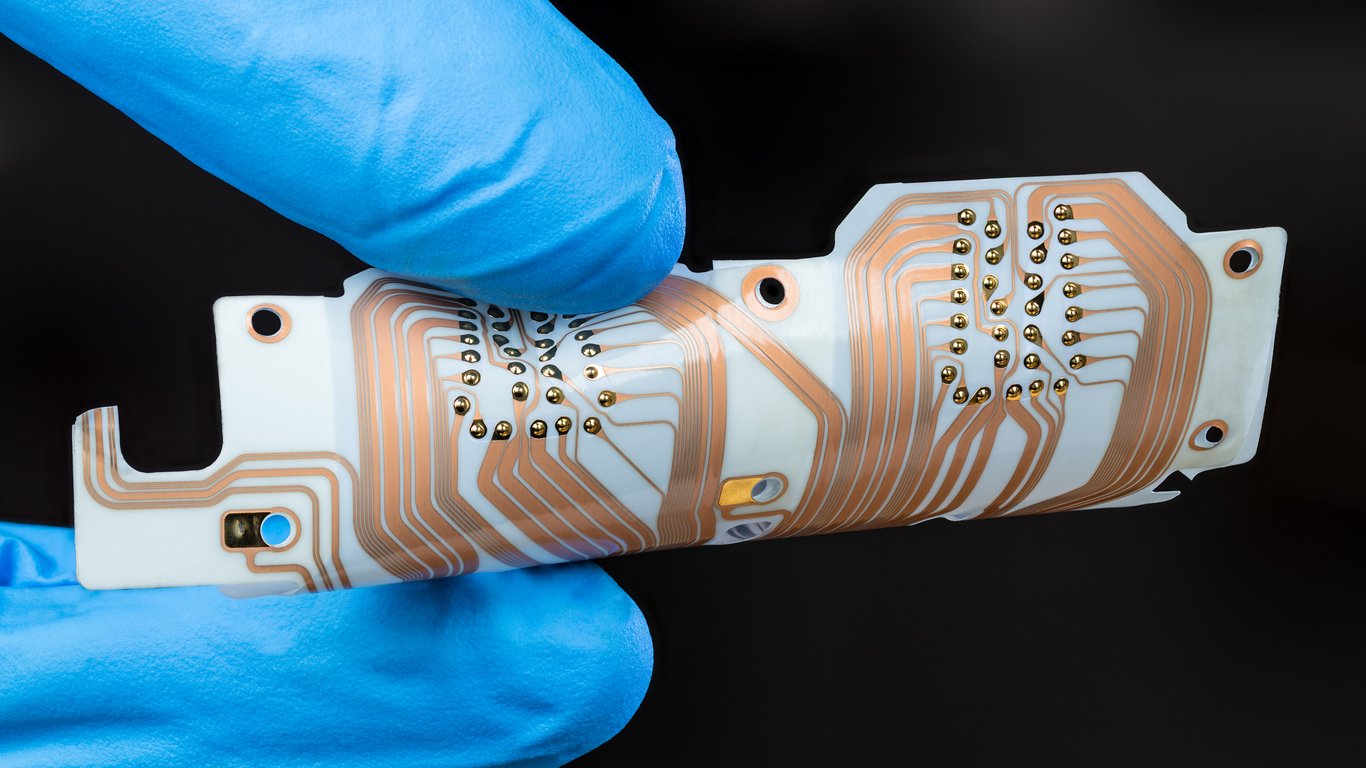
Flexible PCB Solutions for Every Application
Flexible printed circuit boards are ideal wherever space, weight, and reliability are key priorities. Cleveland Circuits supply flexible and flex-rigid PCBs that help electronics manufacturers meet these demands across multiple industries. In aerospace and defence, our lightweight boards replace bulky wiring harnesses to improve reliability in high-performance systems. In medical and healthcare applications, our flexible circuits support compact, sterilizable designs for diagnostic, wearable, and implantable devices. Automotive and EV manufacturers benefit from durable flex-rigid assemblies that withstand heat while simplifying wiring in lighting, and power systems. In industrial automation and robotics, our dynamic flex PCBs endure repetitive motion and harsh environments, extending equipment life and reducing maintenance. And in consumer electronics and IoT products, our thin, lightweight circuits enable sleek, space-efficient designs in smartwatches, cameras, and sensors.
We supply single and double sided flex PCBs, multilayer flexible circuits, and flex-rigid combinations, each carefully specified to balance flexibility, strength, and signal integrity. The result is dependable, high-performance circuitry that delivers long-lasting reliability across every application.
Assembly and Integration Options
Cleveland Circuits can deliver bare circuit boards or fully assembled boards, with SMT or hand-fit components as required. We can also arrange integration into housings or complete assemblies, supporting you from concept through to production readiness.
While flexible PCBs are typically more costly than rigid alternatives due to their materials and complexity, the benefits (weight reduction, design flexibility, and space optimisation) often justify the investment in high-performance designs.